


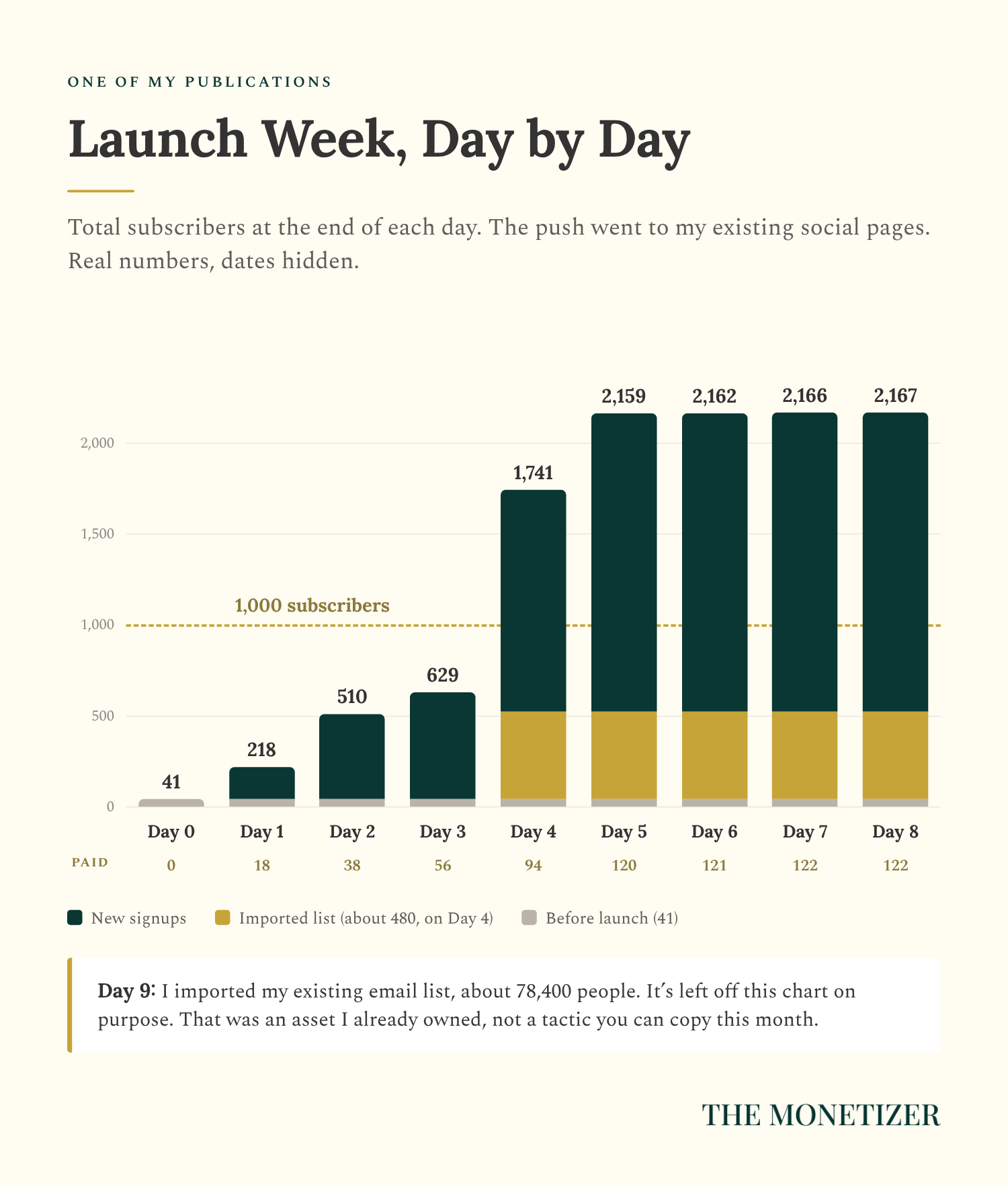
The day before its launch, one of my publications had 41 subscribers. By the end of Day 5, it had 2,159, and 120 of them were paying.
I’m not naming that publication. I keep its numbers private, so its name and logo are blurred in every screenshot below. Every number about it is real, though, and comes straight from its Substack dashboard.
Almost none of those first subscribers found the publication on Substack. The launch push went to my existing social pages, and Facebook alone sent more signups than everything else combined. About 480 more people came from a small list imported on Day 4. Then on Day 9, I imported an email list I already owned, about 78,400 people, which is why that day isn’t on the chart.
That’s not a confession. It’s the most useful thing those numbers can teach you: your first 1,000 subscribers will mostly come from people who already know you, and Substack’s network is what keeps new ones coming after that.
This guide gives you both halves. By the end, you’ll have:
A two-hour setup audit that plugs the leaks before you send anyone to your page.
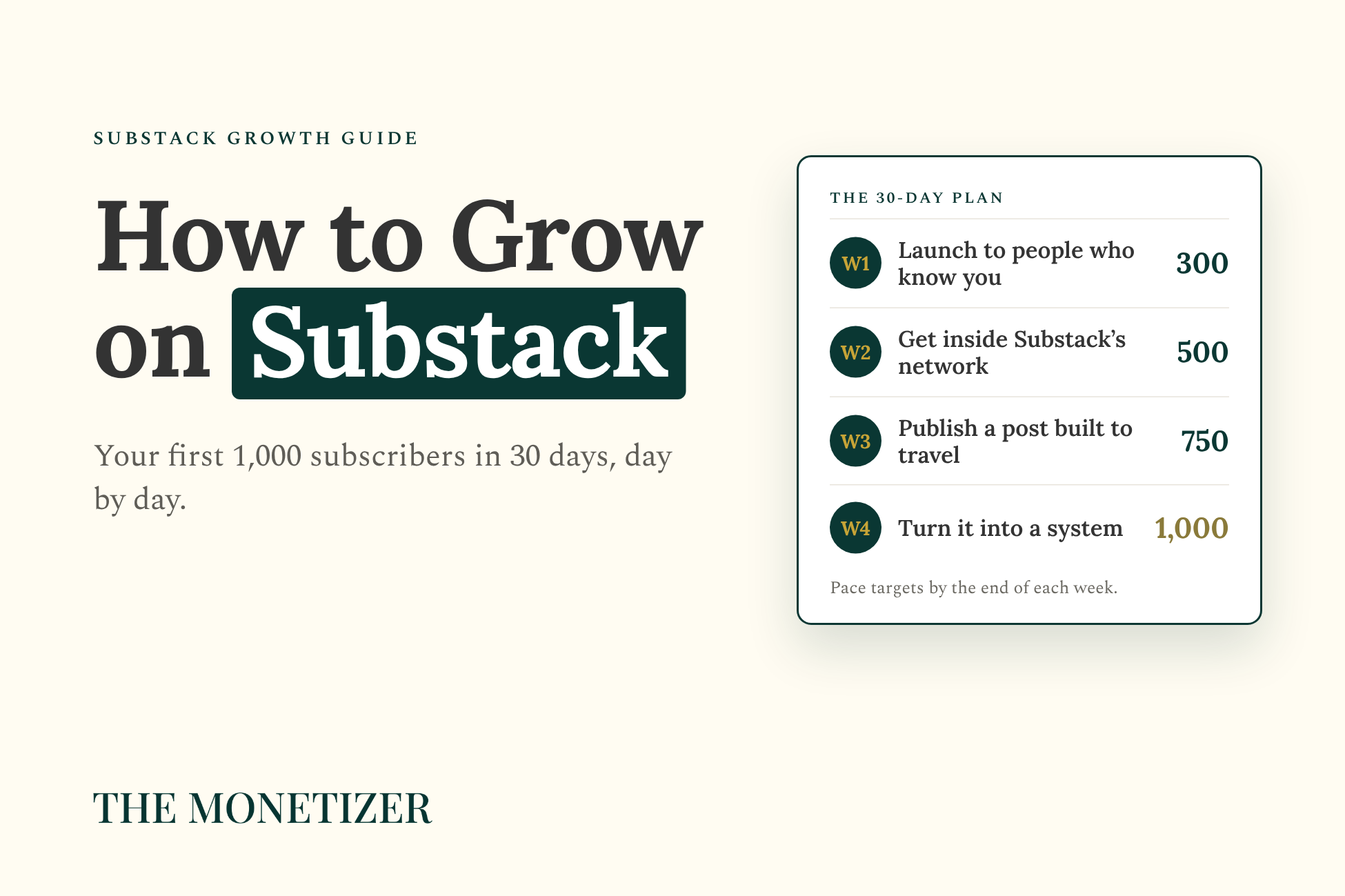
A 30-day plan, day by day, built on the three things that grow my publications: free posts, daily Notes, and running Substack like a media publication instead of a newsletter.
Pace targets for Days 7, 14, 21, and 30, so you know early if you’re off track and what to fix.
The exact messages to send to friends, readers, and other writers, word for word.
The whole plan is free, right here. At the bottom, you can grab a printable version with the trackers and scripts.
What Actually Got My Publication to 1,000
Look at where the first month’s signups came from, with imports left out.
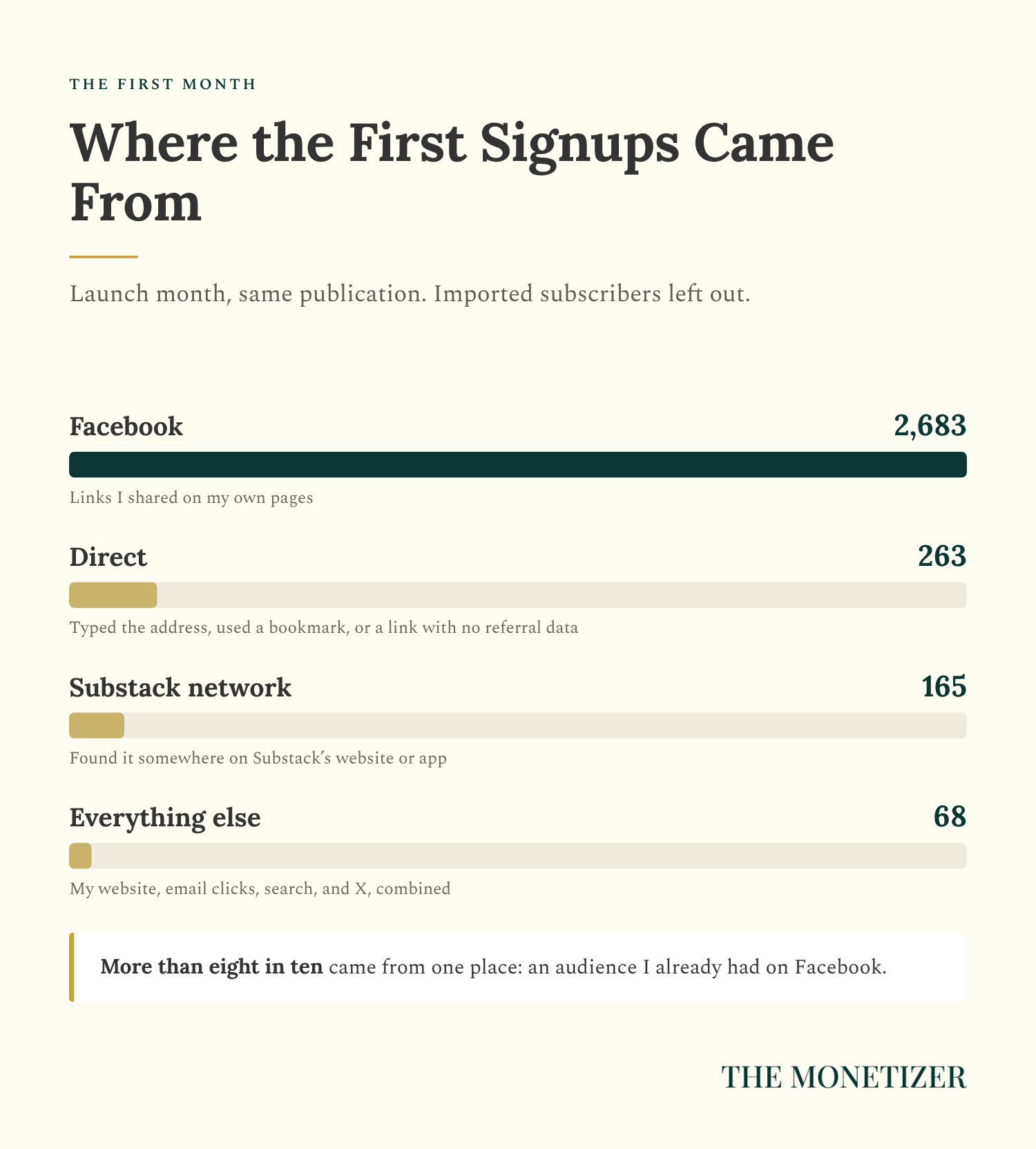
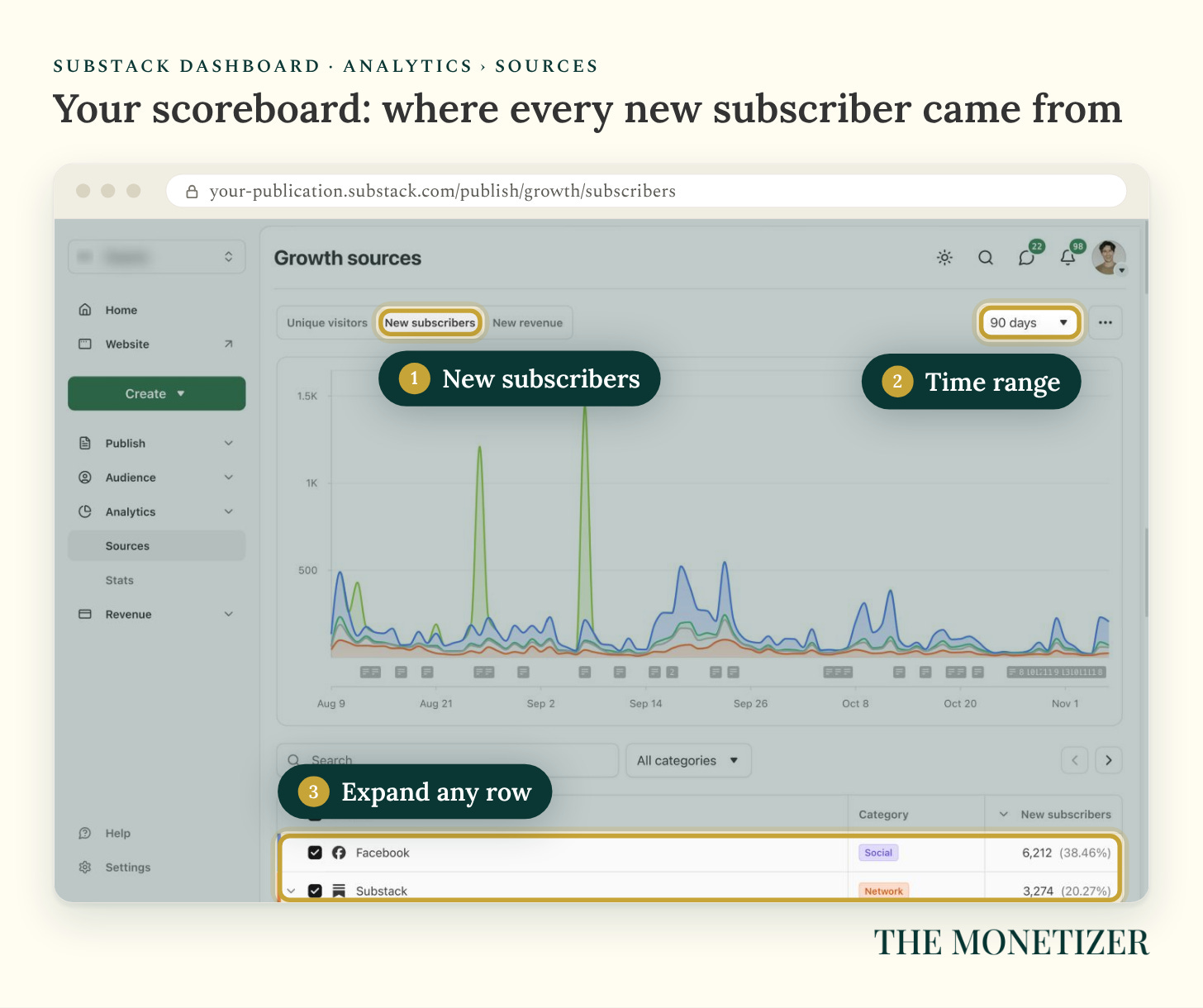
Facebook sent 2,683 people. “Direct,” which is Substack’s label for people who typed the address, used a bookmark, or clicked a link that didn’t pass along where it came from, sent 263. Substack’s own network sent 165.
So the fast start came from an audience I already had on social media, plus email lists I already owned. If you’ve been told that Substack will hand you 1,000 strangers in your first week, this is your reality check.
And the spike didn’t last. The publication picked up about 1,050 new signups on Days 4 and 5, then grew by 8 over the next three days combined, because a launch is an event and events end. What keeps a publication growing is a system that brings people in every day, whether or not you’re promoting anything.
Why Substack’s Network Matters More Now
Now look at the same publication in the 90 days to November 6, 2026, long after the launch.
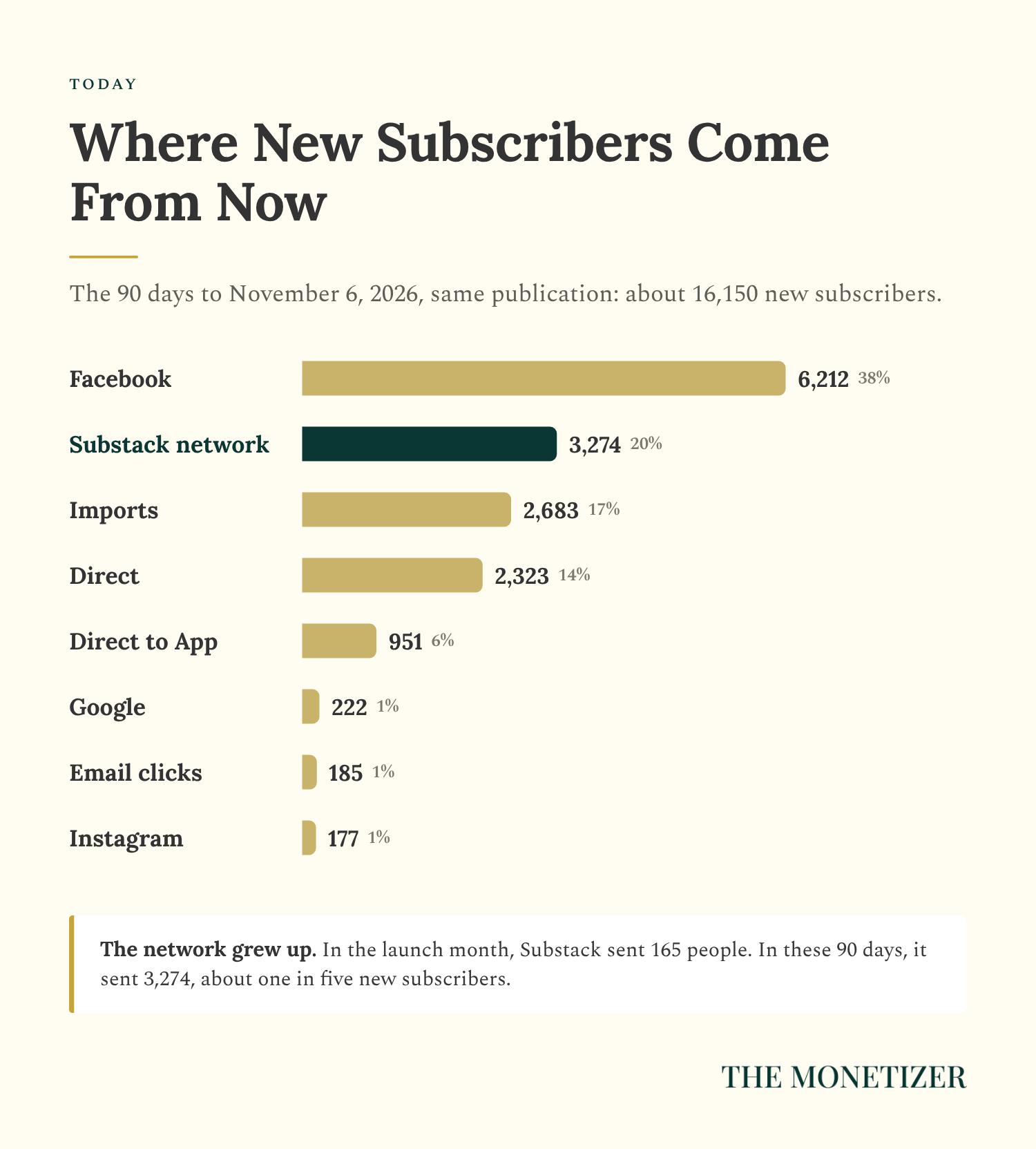
In those 90 days, Substack’s network sent 3,274 new subscribers, about one in five. Facebook still leads, but the network has become the publication’s second-biggest source.
That matches what Substack says is happening across the whole platform. In October 2025, Substack said its app had driven more than 32 million free subscriptions and nearly half a million paid ones in the previous three months (Substack). Substack has also shipped a pile of growth tools in the last year, including Creator match in August 2026 and freewalls in October.
That’s why now is a good time to run this plan. You can borrow the attention you already have to get started, then let the network compound it.
The Math: 33 Subscribers a Day
A thousand subscribers in 30 days works out to about 33 a day. You won’t get them evenly, and you shouldn’t plan as if you will.
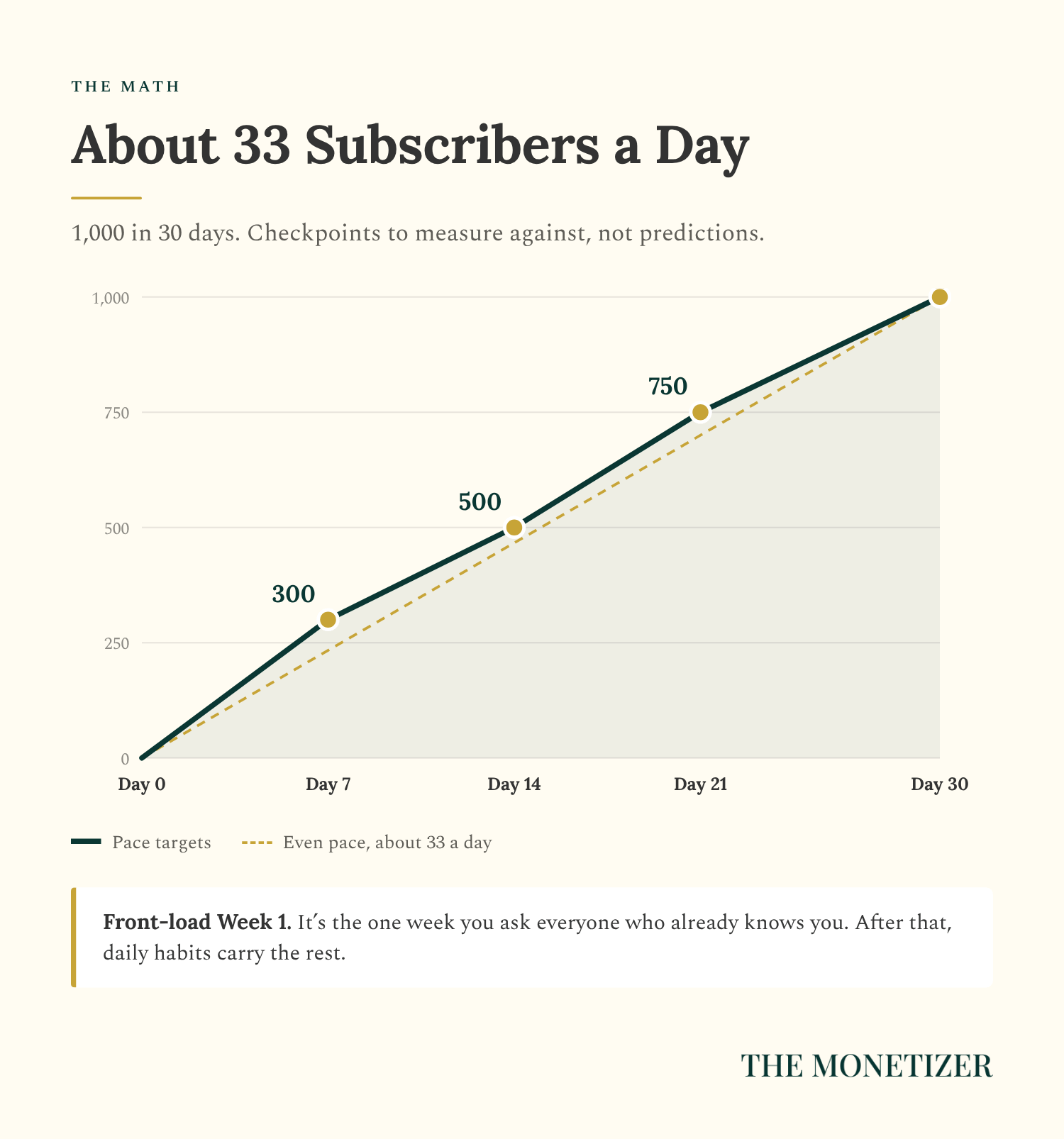
The first week should be your biggest, because that’s when you ask the people who already know you. After that, growth comes from Notes, recommendations, and posts built to travel. These pace targets are checkpoints for you to measure against, not predictions:
Day 7: 300 subscribers
Day 14: 500
Day 21: 750
Day 30: 1,000
Be Honest About Your Starting Point
This plan assumes you’ve already set up your publication and published a few posts. My audience isn’t required, but some starting point is: social followers, a professional network, a community you’re active in, past clients, or an email list.
If you’re starting with almost no one, run the exact same plan and judge yourself by pace, not by the 30-day deadline. A slow first month isn’t a verdict. Amie Tollefsrud, a Monetizer student, started her Substack, Lazy Millionaire, from zero last year. She’s now approaching half a million dollars a year on Substack. Her result isn’t typical, and it took longer than 30 days, but it shows what starting from zero can turn into.
The other thing this plan asks for is time: about an hour a day for 30 days, and more on the days you publish. Block it on your calendar now.
The 30-Day Plan at a Glance
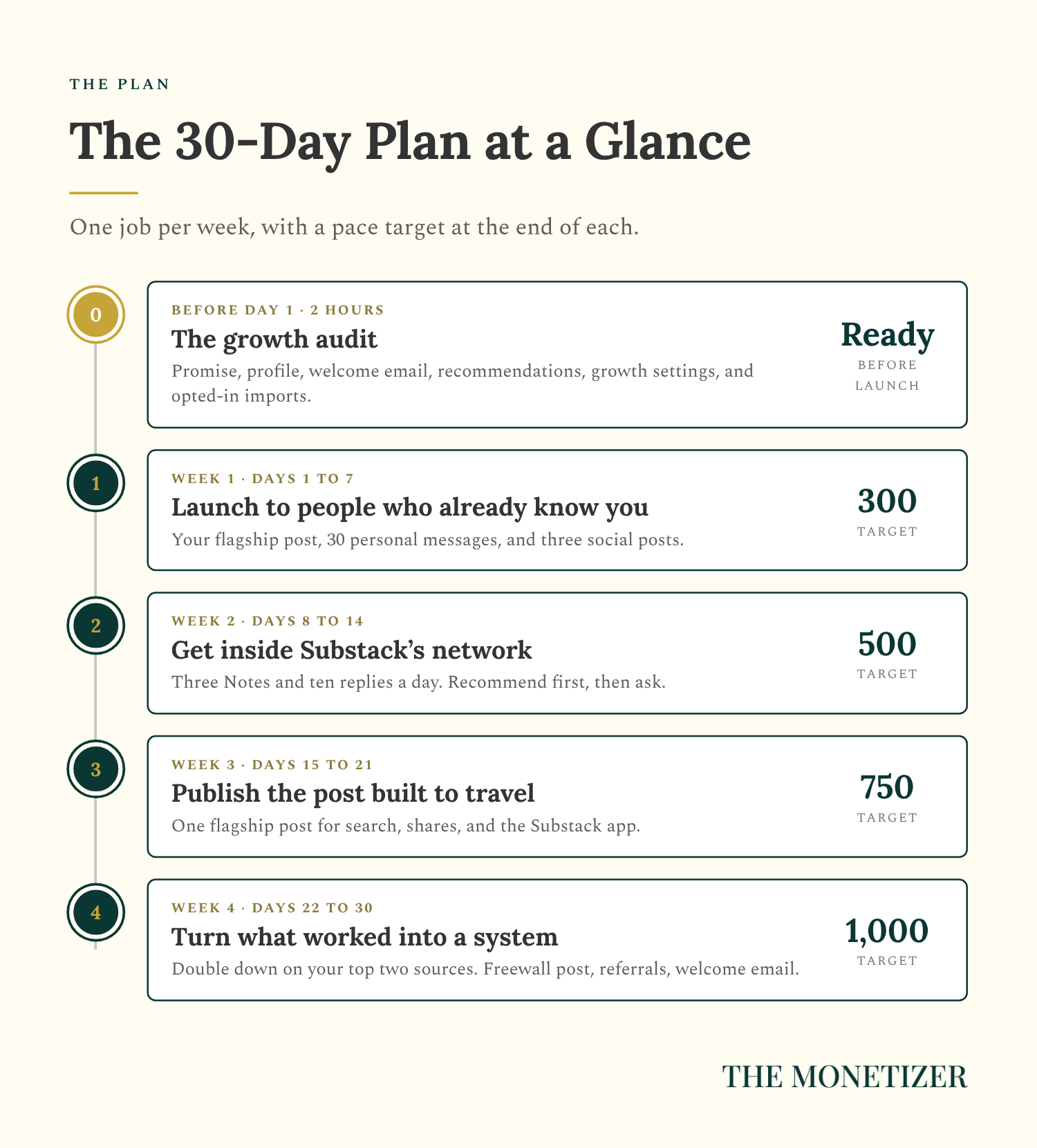
Each week has one job. Do the setup audit first, then work through the weeks in order, because each one feeds the next.
Before Day 1: The Two-Hour Growth Audit
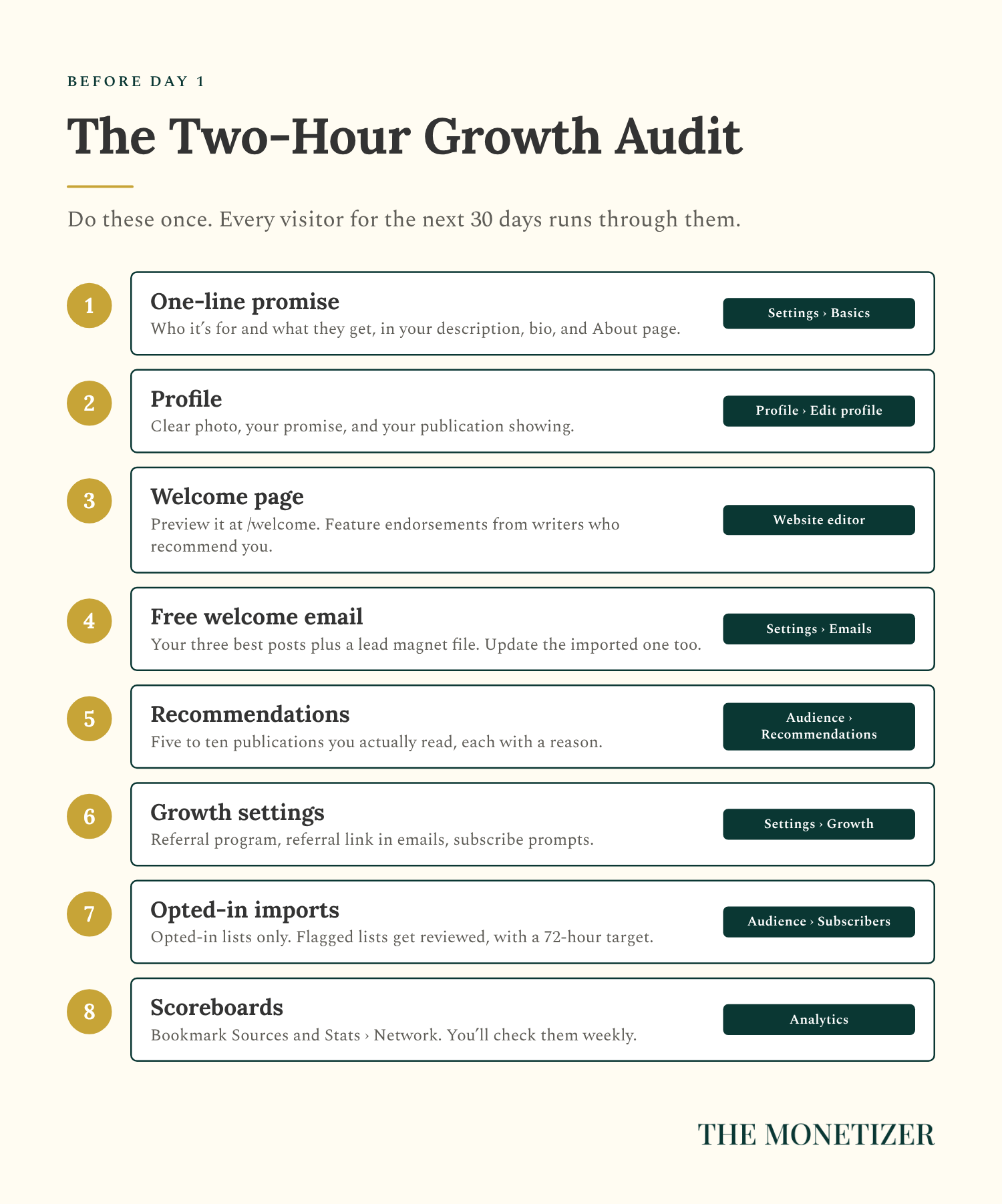
You’re past the basics, so this isn’t a setup checklist. It’s the short list of settings that decide whether a visitor becomes a subscriber, and whether that subscriber brings in someone else. Fix them before you send a single person to your page.
1. Write a One-Line Promise
Say who the publication is for and what they get, in one sentence. “Weekly breakdowns of [topic] for [specific reader]” beats “thoughts on life and work” every time. Put it in three places: your publication description in Settings › Basics, which shows on your Welcome page, your profile bio, and the top of your About page.
2. Fix the Profile That Notes Readers See
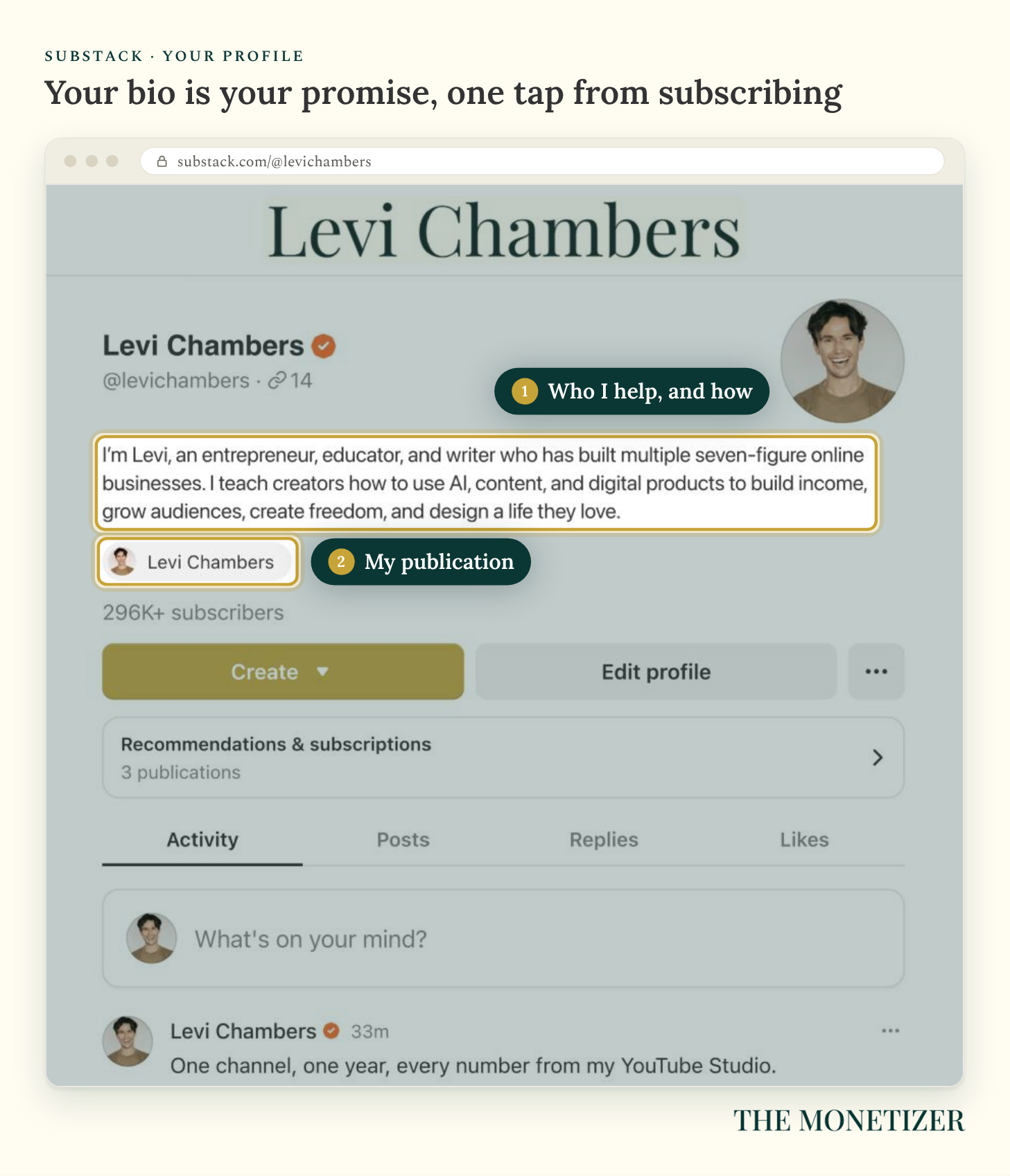
Your profile is where Notes readers go to see who you are, and profile visits sent my publication 194 subscribers in those 90 days. It needs a clear photo, your promise, and your publication showing underneath so people can subscribe in one tap.
3. Check Your Welcome Page
First-time visitors see your Welcome page automatically, and it also lives at /welcome on your publication (Substack). Open it in a private browser window. You change it in the Website editor, and once other writers recommend you, you can feature up to three of their endorsements on it from the Recommendations section.
4. Make the Free Welcome Email Do a Job
A lot of welcome emails say thanks and nothing else. Yours should give new subscribers a reason to stay: your three best posts, plus something useful to download. Substack lets you add files to welcome emails (Substack), so attach a lead magnet, like a checklist or a template, and say what it is in the first line.
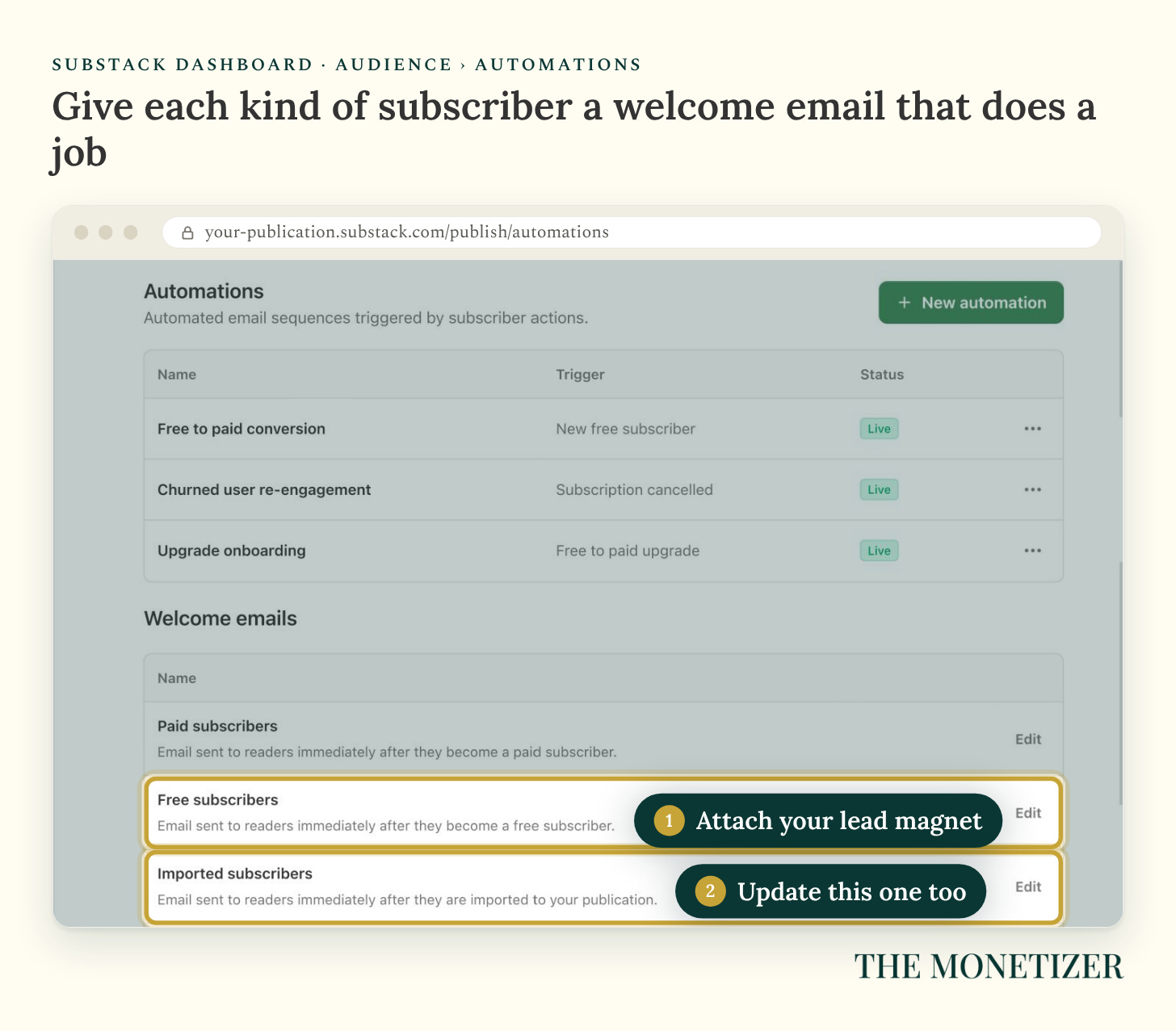
Edit them in Settings › Emails (Substack). Some dashboards also list them under Audience › Automations, as in the screenshot above. Two catches. Imported subscribers get their own welcome email, so update that one too. And if your publication’s theme is set to Profile instead of Custom, welcome emails don’t start sending until you’ve published at least two posts. For what to build after the welcome email, read the seven automations I’d build first.
5. Recommend Publications You Actually Read
Go to Audience › Recommendations and recommend five to ten publications your readers would love, each with a one-line reason. Right after someone subscribes to you, Substack may show them up to three of your recommendations, each one a single click to subscribe (Substack). Recommending first also matters for Week 2. More on that below.
6. Turn On the Growth Settings
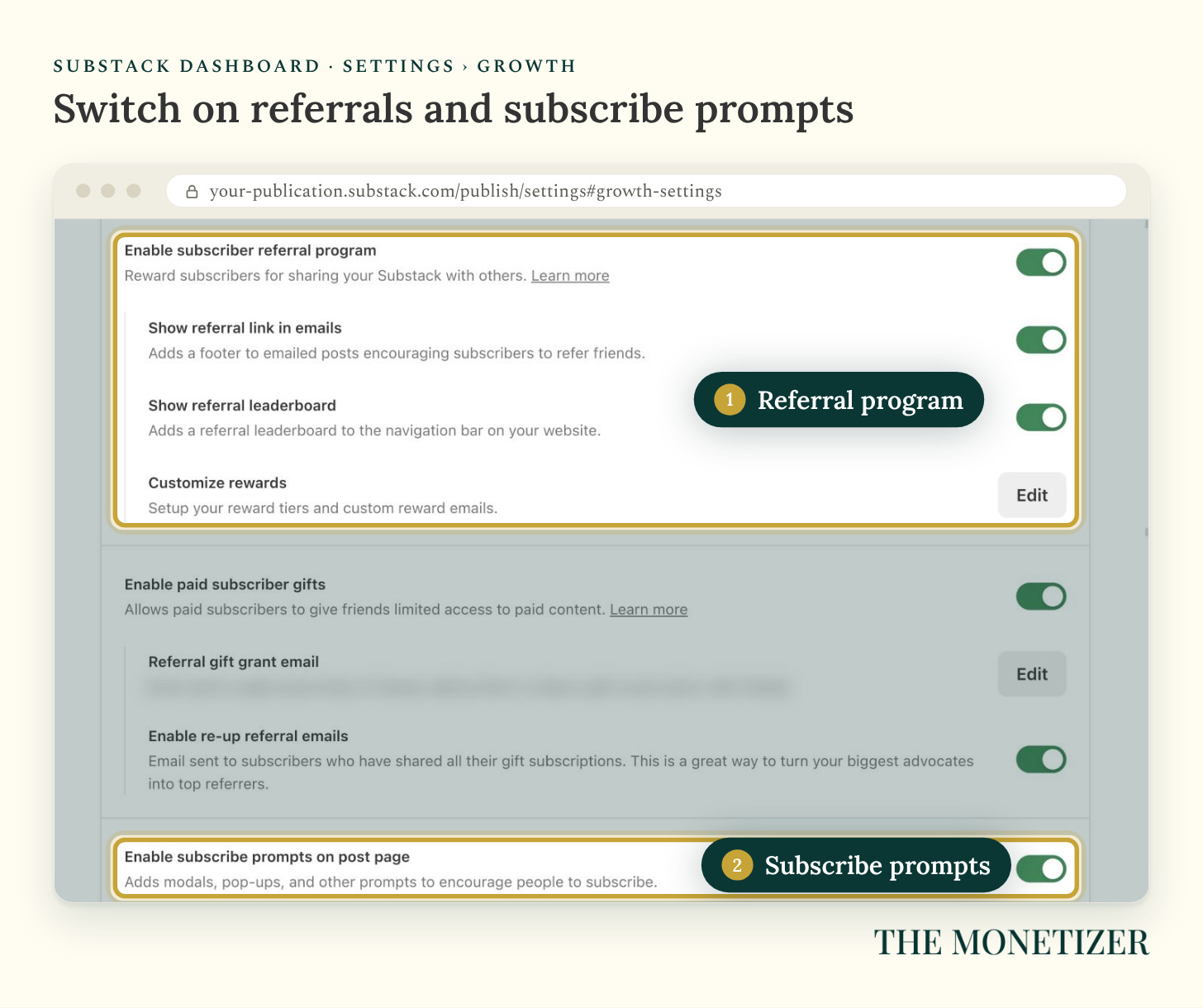
In Settings › Growth, switch on “Enable subscriber referral program” and “Show referral link in emails.” The referral program rewards readers for bringing in new free subscribers (Substack). While you’re there, turn on “Enable subscribe prompts on post page,” which adds subscribe pop-ups and prompts to your posts.
7. Import Any List of People Who Opted In
If you have an old newsletter list, a course email list, or customers who agreed to hear from you, import it now so those people get your Day 1 post. Go to Audience › Subscribers, click Add subscribers, and upload a CSV.
Substack only accepts lists where everyone explicitly opted in (Substack), and riskier lists go to a review that Substack aims to finish within 72 hours (Substack). That’s why this happens before Day 1. Never import a list of contacts who didn’t sign up for email from you. It’s against Substack’s rules, and it’s a fast way to get marked as spam.
8. Bookmark Your Two Scoreboards
You’ll check these every week:
Analytics › Sources shows where every new subscriber came from.
Analytics › Stats › Network shows how many came through Substack’s app and network features.
Week 1: Launch to People Who Already Know You
Days 1 to 7 are the week my publication’s numbers come from, so copy the mechanism, not the scale. The goal is to get your flagship post in front of every person who already knows and trusts you, then ask them directly.
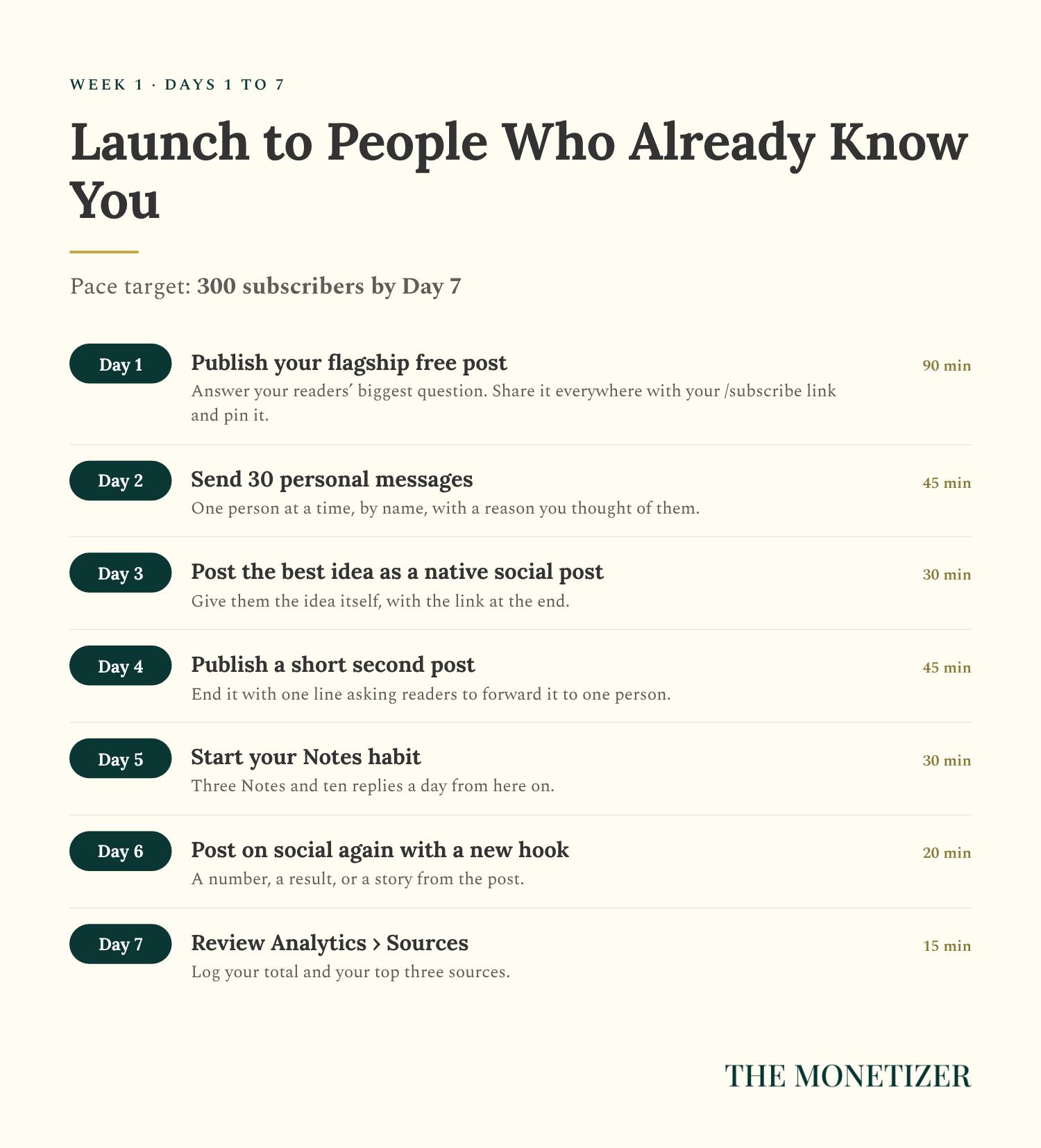
Day 1: Publish your flagship free post. Answer the question your readers ask most, better than anyone else has. Then post it on every social account you have with your subscribe link (yourname.substack.com/subscribe) and pin it.
Day 2: Send 30 personal messages. One person at a time, by name, with a reason you thought of them. The script is below.
Day 3: Post the best idea from your flagship post as a native social post. Not “new post is up.” Give them the idea itself, with the link at the end.
Day 4: Publish a short second post and end it with a single line asking readers to forward it to one person.
Day 5: Start your Notes habit. Three Notes and ten replies a day from here on. Week 2 shows you exactly what to post.
Day 6: Post on social again with a different hook: a number, a result, or a story from the post.
Day 7: Check Analytics › Sources. Write down your total and your top three sources.
Use this personal message. Change the brackets and keep it short:
Hey [name], I just launched [publication], a [weekly/biweekly] newsletter about [topic] for [who it’s for]. You came to mind because [specific reason]. The first post is about [topic]: [link]. If it’s useful, I’d love for you to subscribe. No pressure either way.
Thirty messages feels slow, and that’s the point. A personal ask from someone they know is much harder to scroll past than a broadcast post. If more than 30 people would actually want this, send more.
Week 2: Get Inside Substack’s Network
Your launch spike will probably fade by the end of Week 1. Mine faded after Day 5. Week 2 is where you build the daily habits that replace it.
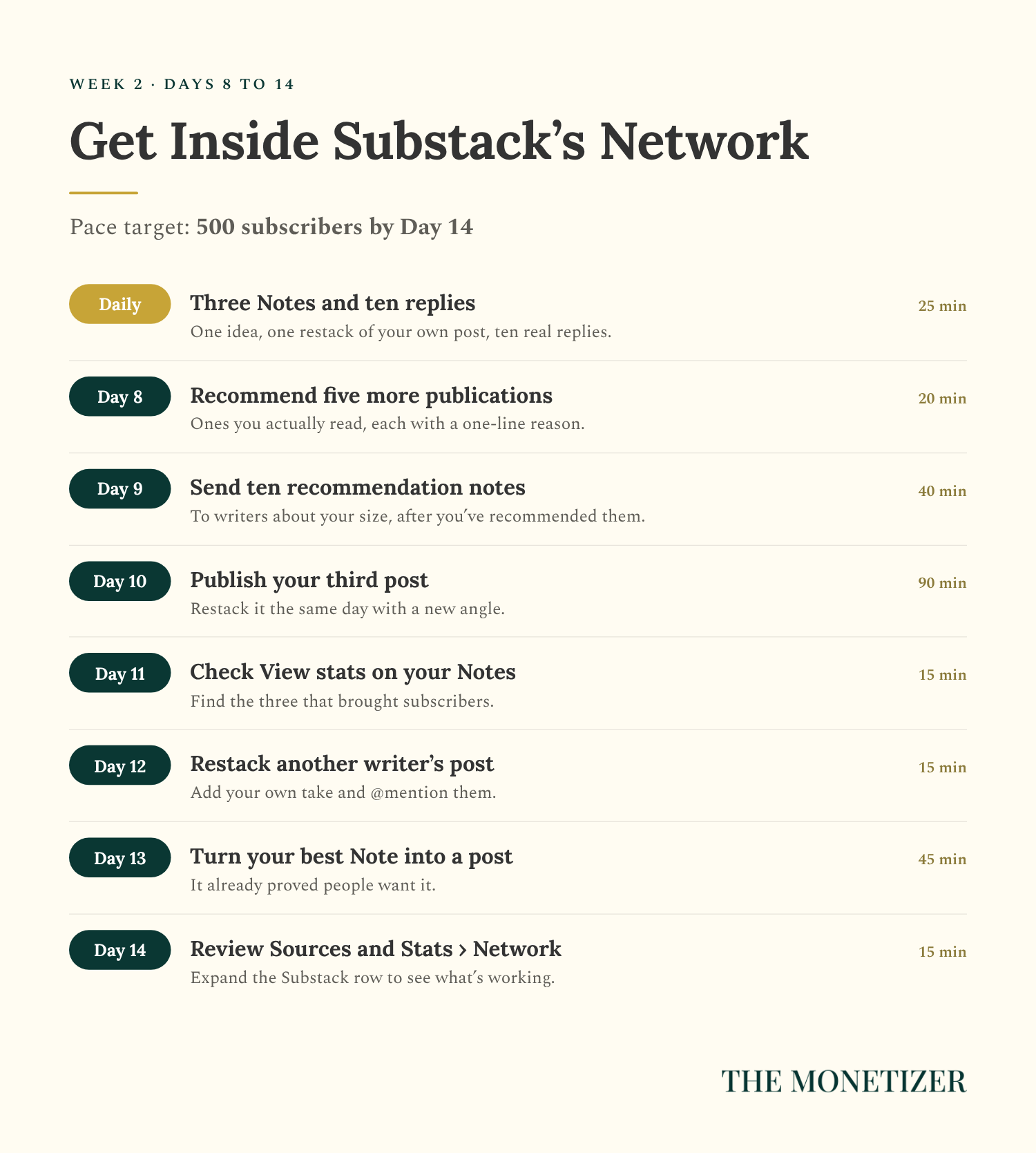
Every day: three Notes plus ten replies (the formula is below).
Day 8: recommend five more publications you read, each with a reason.
Day 9: send ten writers around your size the recommendation note below.
Day 10: publish your third post.
Day 11: open “View stats” on your Notes and see which ones brought subscribers.
Day 12: restack another writer’s post with your own take, and @mention them.
Day 13: turn your best-performing Note into a short post.
Day 14: check Analytics › Sources and Stats › Network.
What “Substack Network” Actually Means
It helps to know what you’re feeding. This is what the network sent my publication over those same 90 days, using the definitions in Substack’s own dashboard.
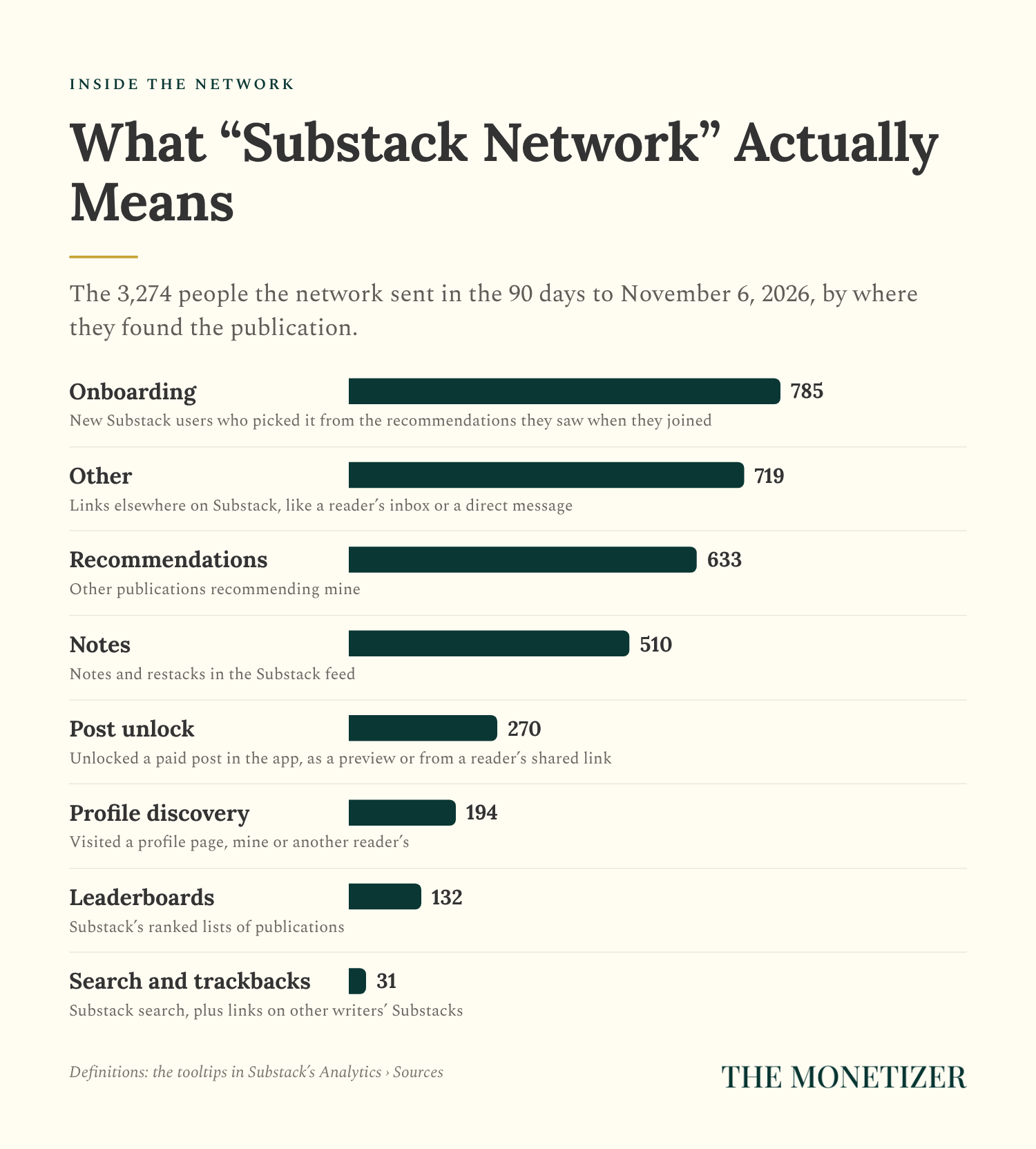
Onboarding means people who picked the publication from the algorithmic suggestions Substack showed them when they joined, so there’s nothing for you to send or post there. Recommendations and Notes are different. You can start working both today, and together they sent this publication 1,143 subscribers in 90 days.
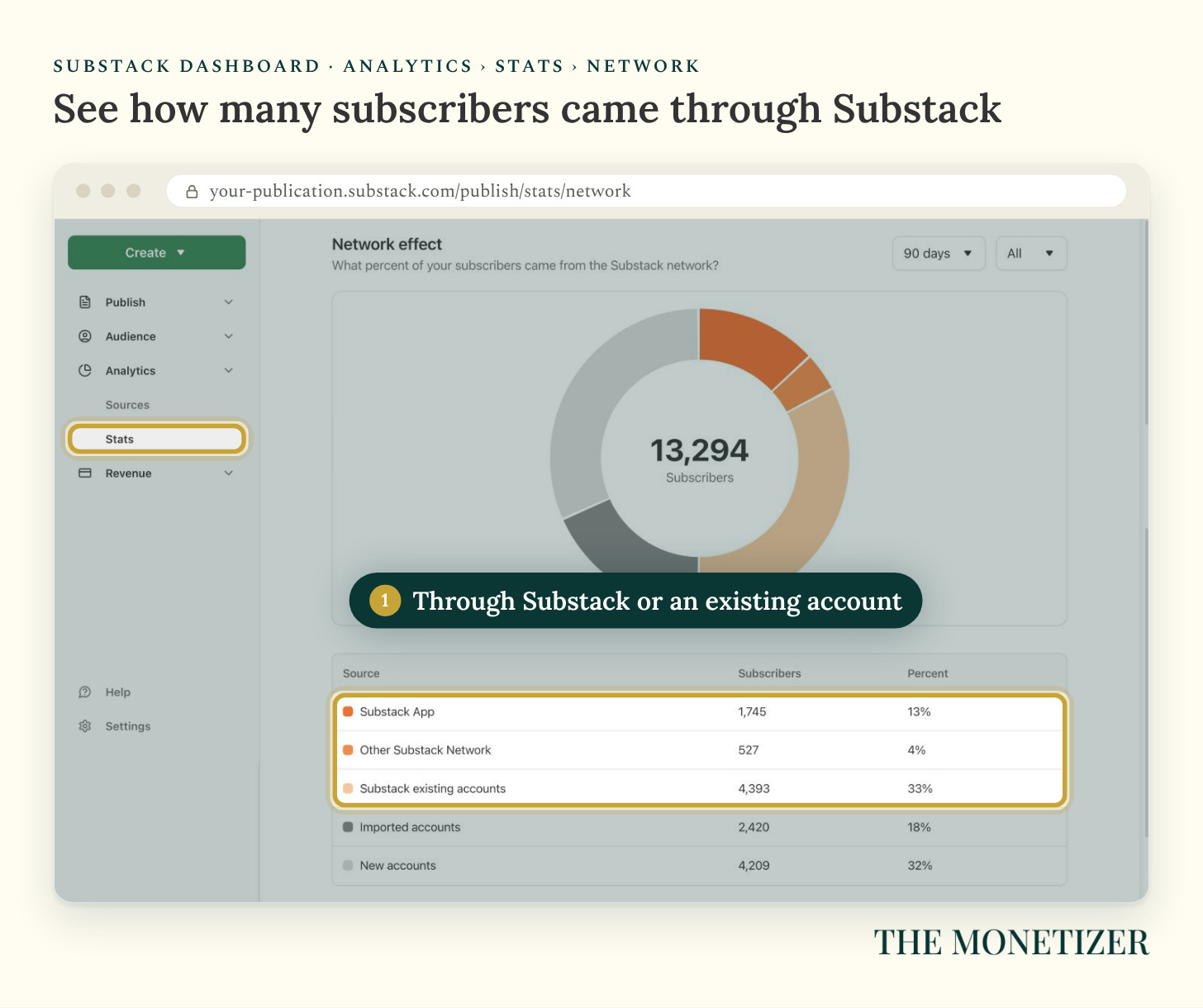
People who already use Substack can subscribe in one tap, because they already have an account. Stats › Network shows how many of your subscribers came that way.
The Daily Notes Formula
I post Notes every single day from every publication, because Substack is becoming a social platform, not just an inbox. Substack says its feed is built to help you reach people beyond your current audience, and that it’s “optimizing for sign-ups and subscriptions” (Substack). The same post names restacking and replying to people you admire as one of the most effective ways to grow.
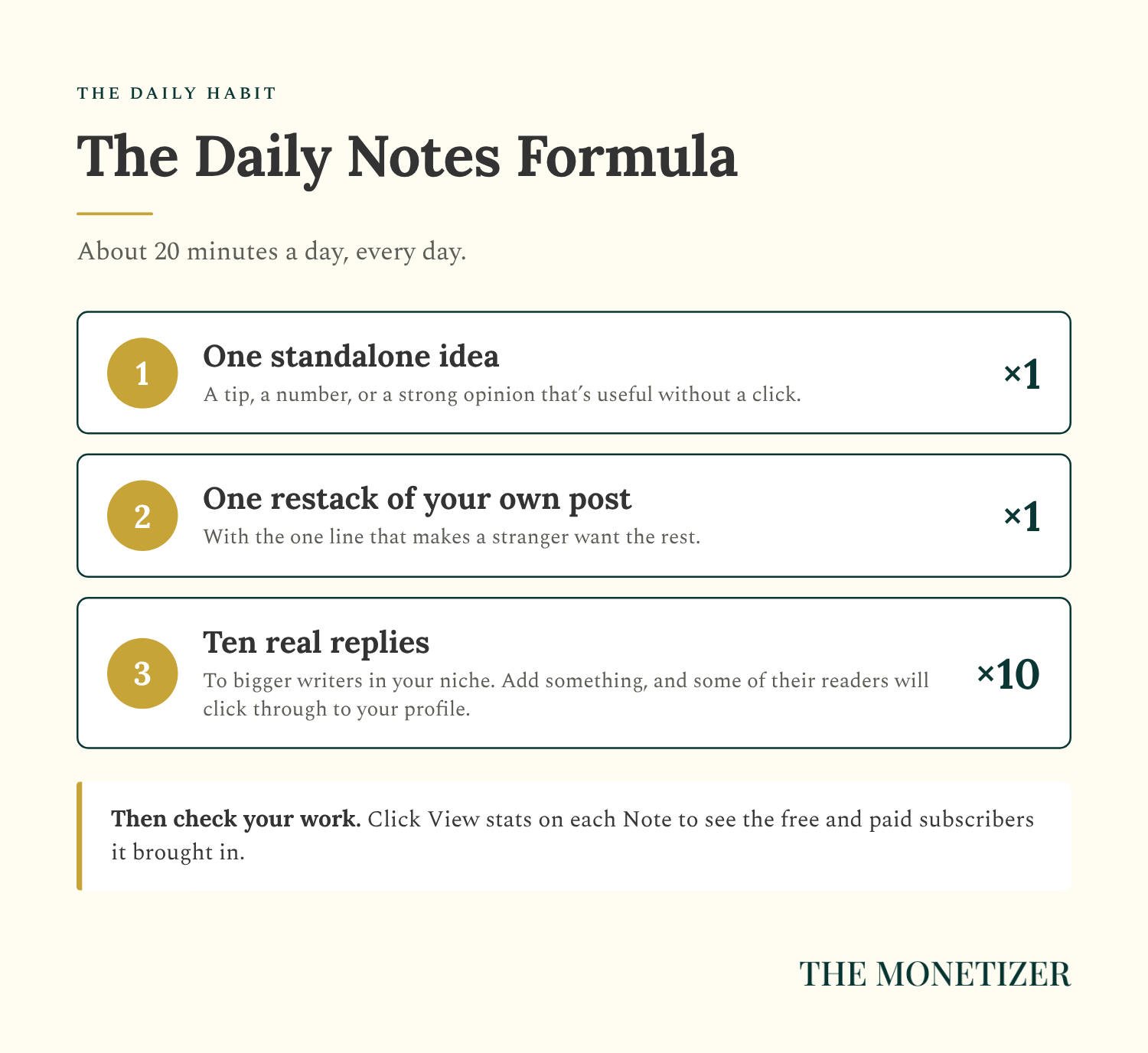
Three Notes a day:
One standalone idea. A tip, a number, or a strong opinion that’s useful without a click.
One restack of your own post with a new angle. Pull out the one line that would make a stranger want the rest.
Ten replies to bigger writers in your niche. Real replies that add something, not “great post!” Their readers see your reply, and some click through to your profile.
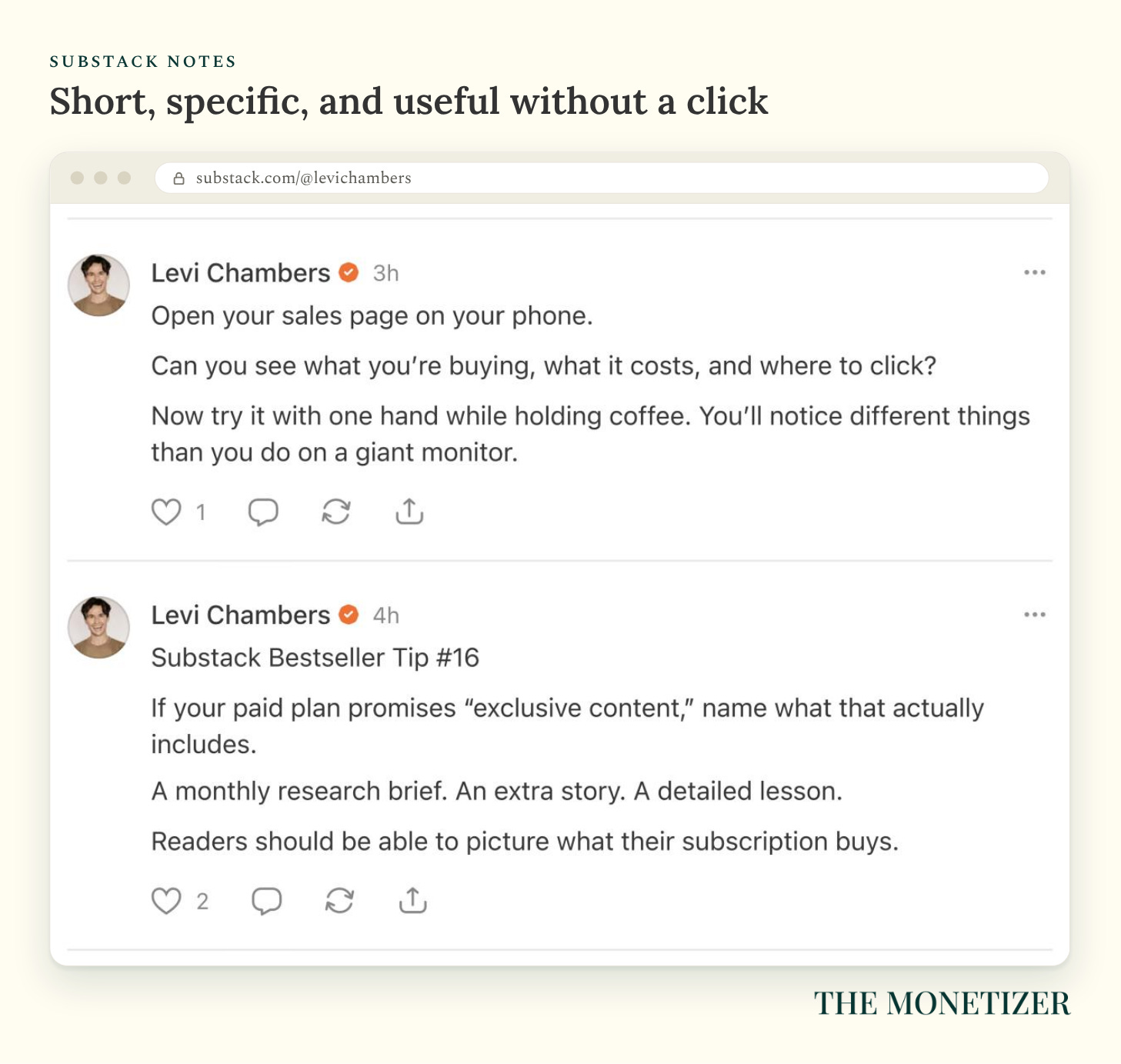
Then check your work. Click “View stats” on any Note to see the new free and paid subscribers it brought in (Substack). Do more of what’s working and drop what isn’t. For the full playbook, read my ultimate guide to Substack Notes and how the Notes algorithm works in 2026.
Recommend First, Then Ask
So far, 102 publications recommend mine, and those recommendations have sent it 1,934 subscribers.
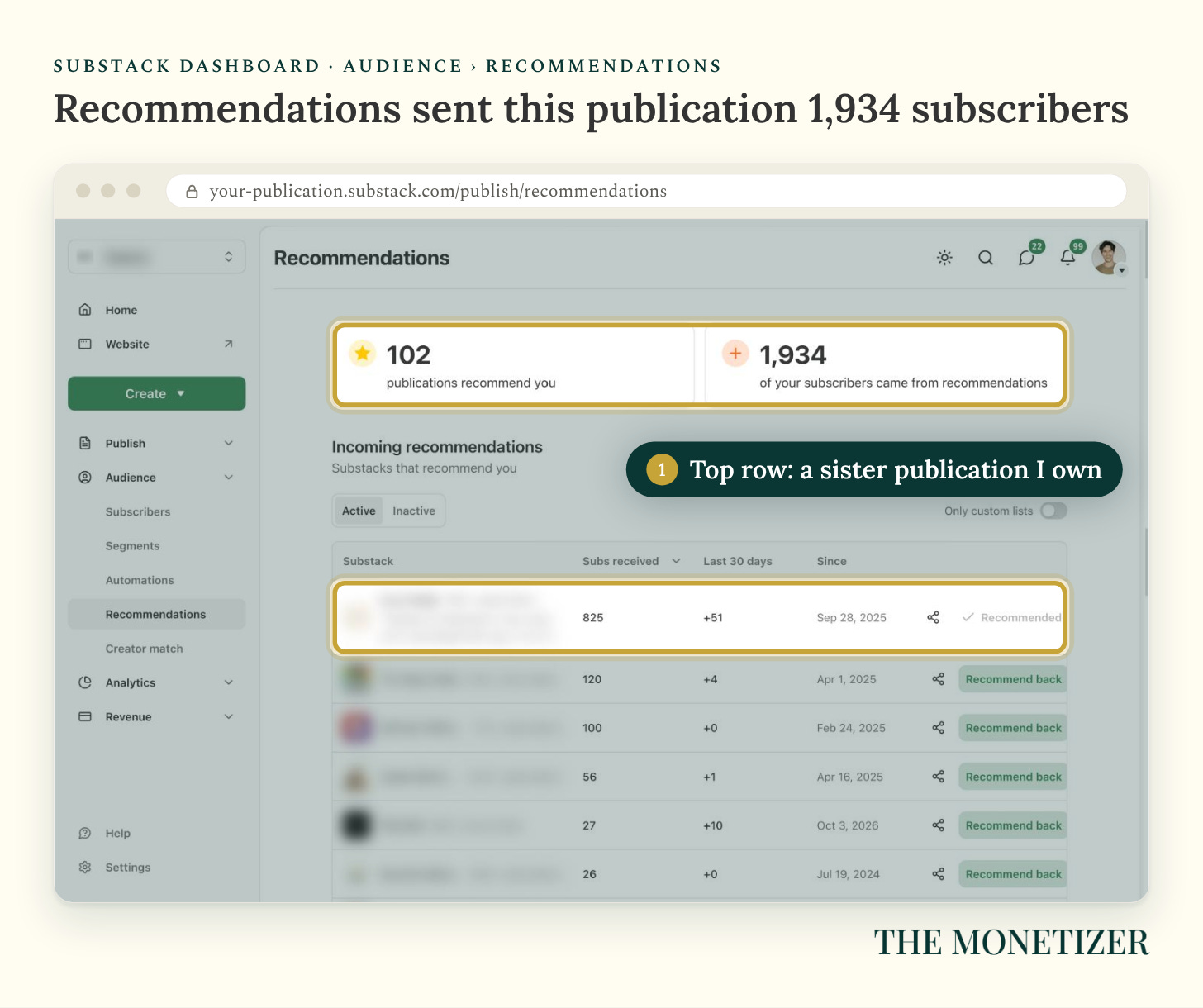
Be clear-eyed about that table. The top recommender is another publication I own, and it sent 825 of those 1,934. After that, the numbers drop fast: 120, 100, 56, 27, 26. Recommendations work best between publications whose readers overlap, so don’t chase big names who’ve never heard of you.
Substack says a creator who makes a recommendation is three times more likely to receive one (Substack). So recommend first, and only recommend publications you’d actually tell a friend about. Then send this:
Hi [name], I’ve been reading [their publication] since [when or which post], and I just added it to my recommendations because [specific reason]. I write [your publication] for [who it’s for]. If you think your readers would like it, I’d be honored to be in your recommendations too. Either way, I’m glad I found your work.
No trades, no pressure, no “rec for rec.” Some people will say yes. Some won’t reply. Both are fine.
Week 3: Publish the Post Built to Travel
Free articles are the growth engine for my publications. In Days 15 to 21, you build one post for search, for shares, and with a headline that makes Substack readers tap, because one post built that way can outgrow a month of everything else. My proof: 10 Niches That Could Make You $100K a Year on Substack brought in 1,100 new subscribers in its first week, from the Substack app alone.
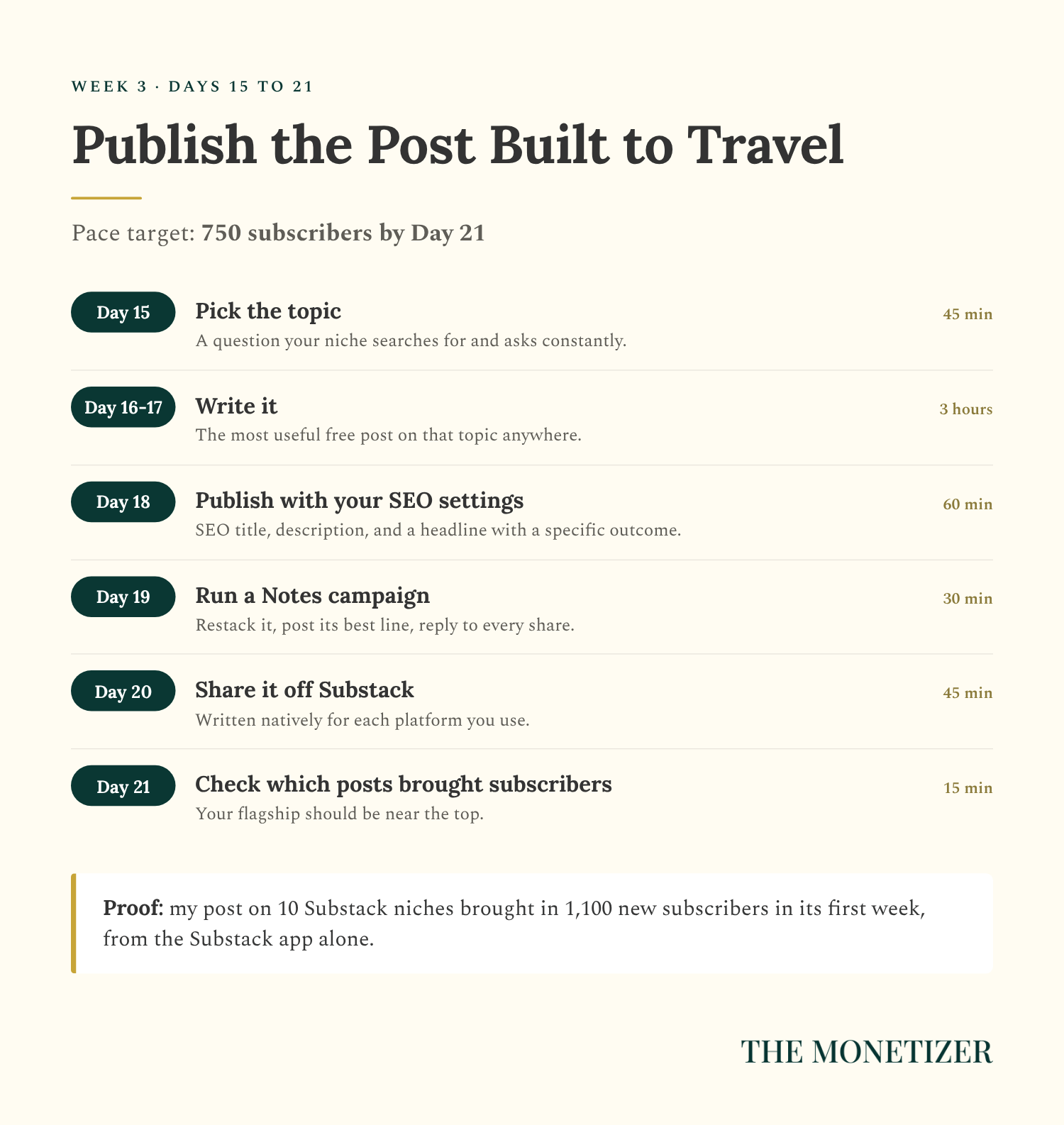
Day 15: Pick the topic. Find a question people in your niche search for and ask about constantly. The questions people sent you in Week 1 are a good place to start.
Days 16 and 17: Write it. Make it the most useful free post on that topic anywhere: specific steps, real examples, and something people would save.
Day 18: Publish it with your SEO title, description, and a headline that promises a specific outcome. My Substack SEO guide walks through every setting.
Day 19: Run a Notes campaign around it. Restack it with a new angle, post your best line as a standalone Note, and reply to anyone who shares it.
Day 20: Share it off Substack. Post the core idea on every social platform you use, written natively for each one.
Day 21: Check which posts brought subscribers. Ideally, your flagship post is near the top.
Optional: borrow an audience. If you have the time, Substack’s new Creator match, available to every publisher since August 2026, ranks writers with similar audience sizes and interests by how promising a collaboration could be, and lets you message them from your dashboard (Substack). A guest post is the simplest collaboration: Substack puts your guest’s byline on the post and prompts readers to subscribe to them too (Substack).
Week 4: Turn What Worked Into a System
By Day 22, you have three weeks of data. Week 4 is about doing more of what brought subscribers in and building the pieces that keep working after Day 30.
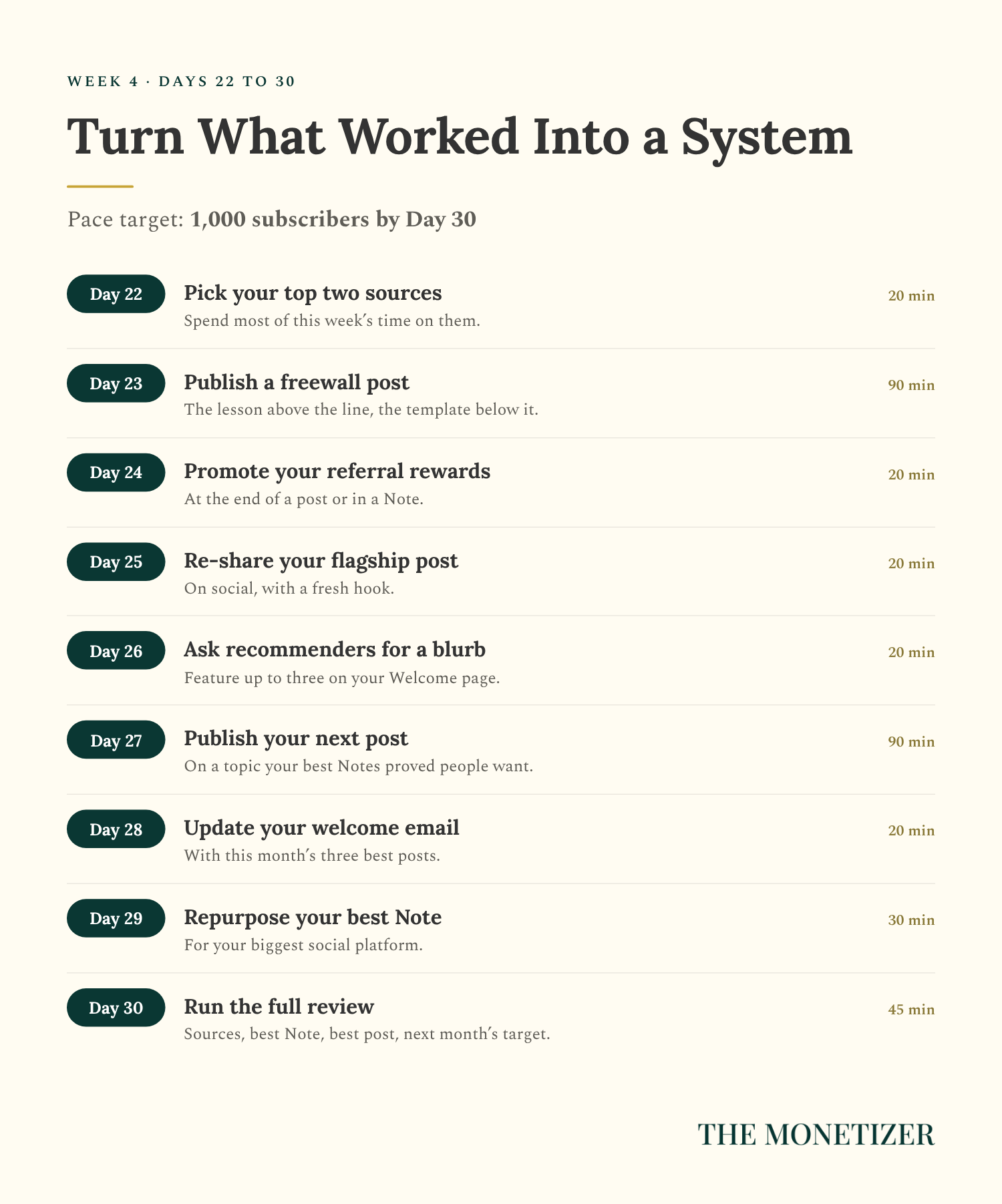
Day 22: Review Analytics › Sources. Pick your top two sources and spend most of this week’s time on them.
Day 23: Publish a freewall post. Substack’s new freewall puts part of a post behind a free subscription. Readers who aren’t subscribed see “Subscribe for free to continue reading” (Substack). Give away the whole lesson above the line and put the template, checklist, or worksheet below it.
Day 24: Tell readers about your referral rewards. If you have paid subscriptions, Substack’s default rewards are complimentary paid subscriptions at 2, 10, and 25 referrals. Free publications can set a custom reward instead (Substack).
Day 25: Re-share your flagship post on social with a fresh hook.
Day 26: Ask two or three writers who recommend you to add a short blurb to their recommendation. You can feature up to three on your Welcome page.
Day 27: Publish your next post on a topic your best Notes proved people want.
Day 28: Update your welcome email with the three posts that brought in the most subscribers this month.
Day 29: Repurpose your best Note into a post for your biggest social platform.
Day 30: Run the full review. Total subscribers, top sources, best Notes, best post. Then set next month’s target.
That last step is the one that turns a 30-day push into a publication. It’s the difference between a launch and a media company: you keep publishing, keep showing up in Notes, and keep sending people back to your best free work.
Behind Pace? Fix the Right Thing
Missing a checkpoint usually means one part of the system isn’t working. Find which one before you do more of everything.
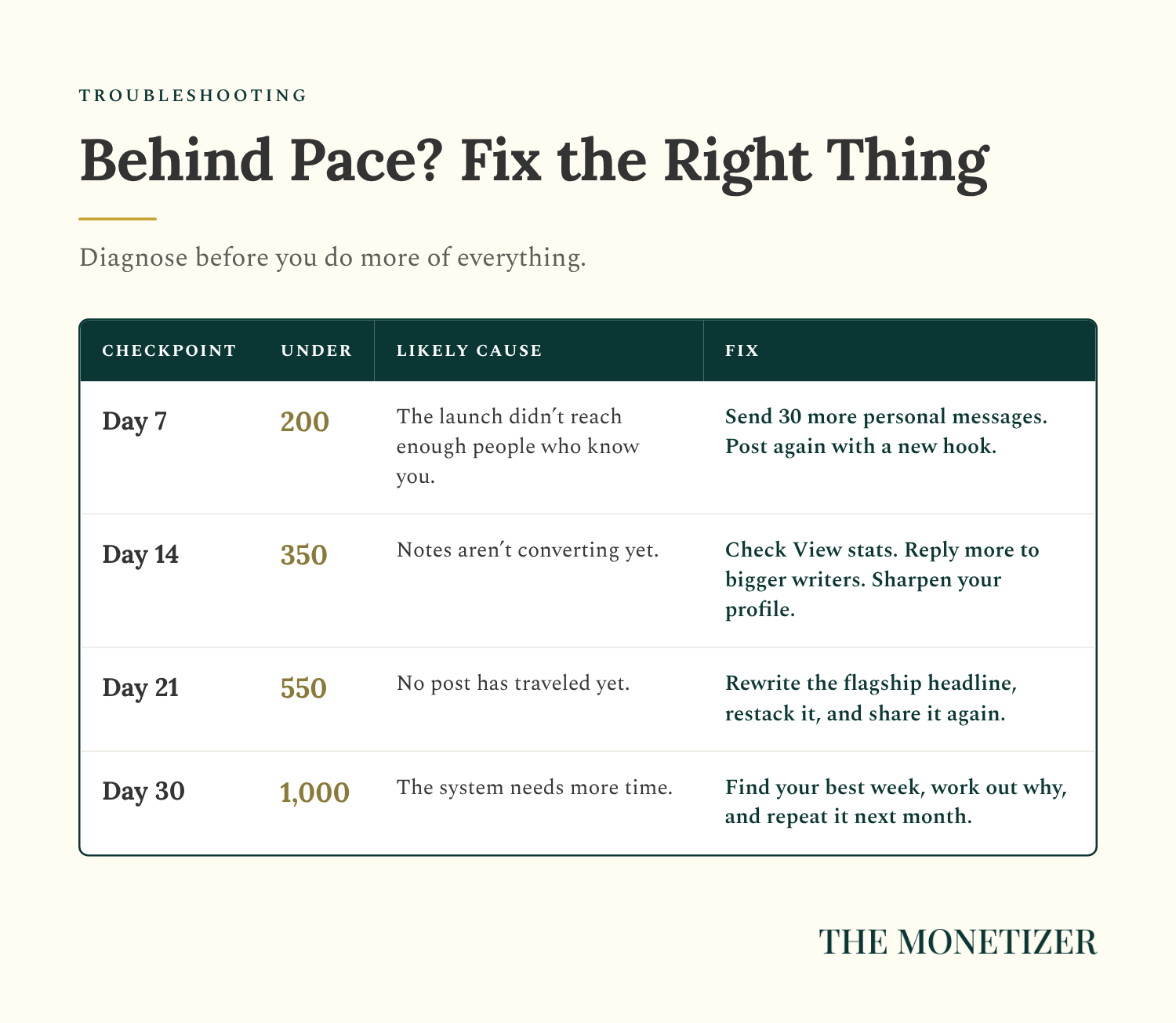
Under 200 by Day 7: your launch didn’t reach enough people who know you. Send 30 more personal messages and post again with a different hook.
Under 350 by Day 14: your Notes aren’t converting yet. Check Notes stats, spend more time replying to bigger writers, and make sure your profile says who the publication is for.
Under 550 by Day 21: no post has traveled yet. Rewrite your flagship headline, restack it with a new angle, and share it again.
Under 1,000 by Day 30: keep going. Look at your best week, figure out what caused it, and do it again next month.
FAQ
How Long Does It Take to Get 1,000 Substack Subscribers?
It depends almost entirely on the audience you start with. My publication crossed 1,000 in its first week, mostly because I had social pages to launch to. If you’re starting from zero, expect it to take longer. This plan gives you checkpoints for Days 7, 14, 21, and 30, so you can measure pace instead of guessing.
How Do I Get Substack Subscribers With No Audience?
Start with the people who already know you, even if that’s 30 friends and former coworkers, and ask them one at a time. Then build daily habits inside Substack: three Notes and ten thoughtful replies a day, plus recommending writers whose readers overlap with yours. Growth inside Substack builds over weeks, so judge yourself by your weekly pace, not by any one day.
Do Substack Notes Help You Get Subscribers?
Yes. Notes sent my publication 510 subscribers in the 90 days to November 6, 2026, and Substack says its feed is optimized for sign-ups and subscriptions. Click “View stats” on any Note to see how many subscribers it brought you.
How Do Substack Recommendations Work?
You pick publications to recommend in Audience › Recommendations. Right after someone subscribes to you, Substack may show them up to three of your recommendations, each one a single click to subscribe. They also show up on your homepage, your profile, and in digest emails that go out about once a month at most.
Can I Import My Email List Into Substack?
Yes, as long as everyone on it explicitly opted in to your emails. Go to Audience › Subscribers, click Add subscribers, and upload a CSV. Some lists go to a review that Substack aims to finish within 72 hours, so import before your launch, not during it.
Where to Go From Here
A thousand subscribers is a real audience. It’s also where the bigger question starts: how do you turn readers into income that renews every month?
That’s what I teach in Substack Best Seller Academy. It’s the documented system behind my $720K in annual recurring revenue on Substack, and more than 10,000 students have trained with me through The Monetizer. If you want to build your Substack into a real business, that’s where to go next.
Get the Printable 30-Day Plan
The free printable version of this plan has everything in one place:
The two-hour setup audit, with every menu path
All 30 days, one page per week, with time estimates
Copy-and-paste scripts for personal asks, recommendations, and collaborations
A daily Notes tracker and a 30-day pace tracker with weekly checkpoints
It’s free for subscribers, and it also arrives in your welcome email when you subscribe.